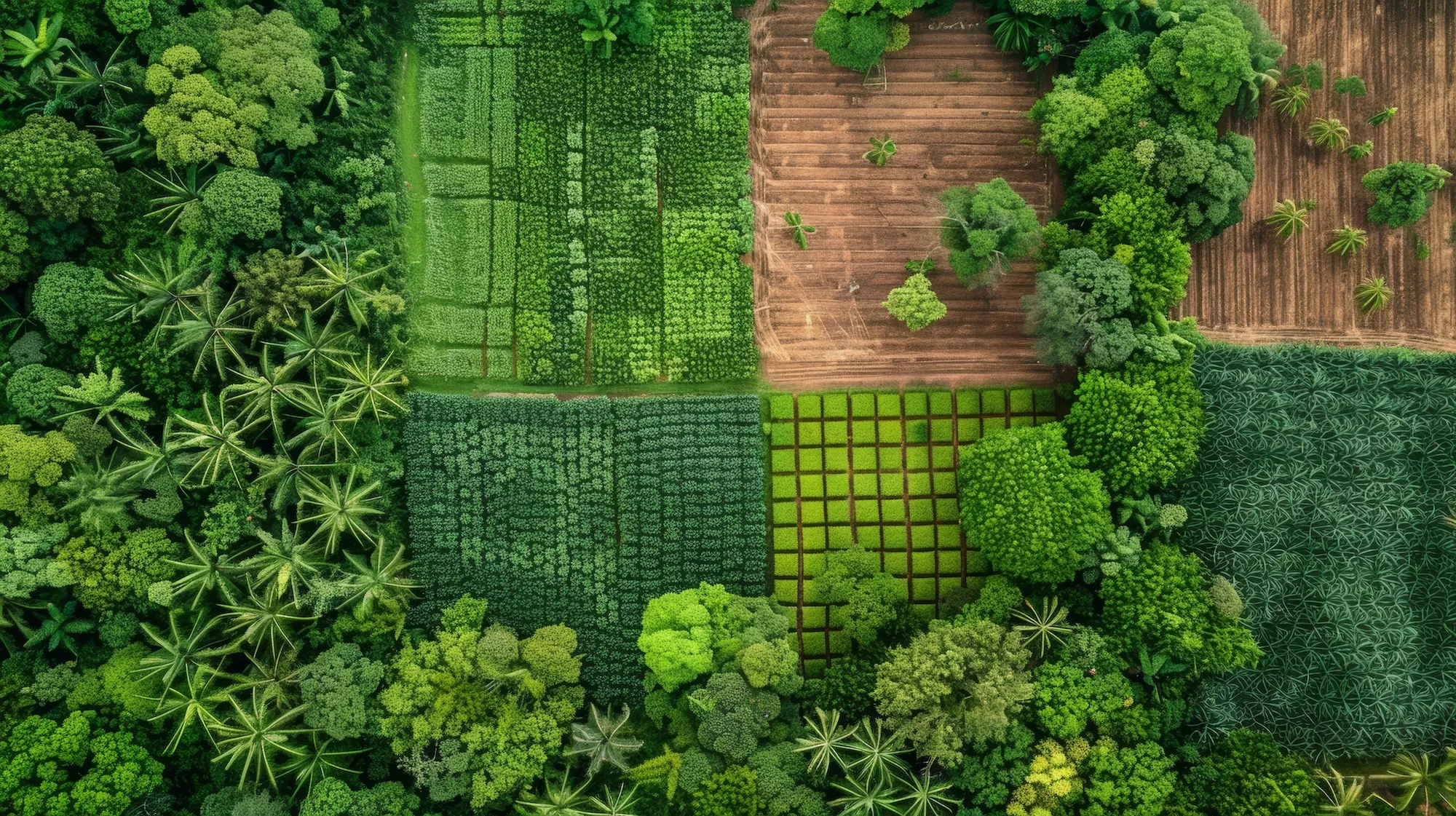


For many producers, the cycle of modern agriculture feels like a treadmill that is slowly speeding up. Every season, the "sledgehammer" approach of broad-spectrum chemicals and intensive tillage seems to require more energy, more water, and higher financial inputs to achieve the same yields. As the soil loses its natural structure, the farm becomes increasingly dependent on external "life support." But across the globe, a different narrative is taking root one that stops fighting nature and starts managing its internal "software."
This is the world of syntropic agriculture. Pioneered by researcher Ernst Götsch on his Fazenda Olhos D'Água in Brazil, this model treats the farm not as a collection of isolated crops, but as a complex, high-performance ecosystem. While the term might sound academic, the practice is deeply grounded in the daily reality of the field. It is a system designed to move a farm from a state of "entropy" where resources and energy are constantly lost to a state of "syntropy," where life and fertility accumulate over time. For the small and medium-sized producer, this transition represents the ultimate move toward financial independence and climate resilience.
The Economic Shift: From Buying Fertility to Growing It
The most immediate concern for any farmer considering a transition is the bottom line. Conventional farming is defined by its reliance on external inputs. In this model, the farmer is essentially a "buyer" of fertility, purchasing nitrogen, phosphorus, and potassium from global markets that are increasingly volatile. When global supply chains shift, or geopolitical tensions rise, the producer’s margins are the first to suffer.
Syntropic agriculture fundamentally flips this script. In a syntropic system, the goal is to "grow" your own fertility. This is achieved through high-density planting and the deliberate management of organic matter. According to technical guidelines from World Agroforestry (ICRAF), diverse agroforestry systems that utilize specific functional species can significantly improve nitrogen fixation and soil structure without the need for synthetic urea. This shift moves the farmer from being a consumer of chemistry to a manager of biology.
Initial Investment vs. Long-Term Wealth
The transition does require a different kind of investment. While conventional farming focuses capital on chemicals and machinery, syntropic farming focuses capital on labor and biodiversity. The initial costs for high-density seedlings and the labor required for the first 24 months of "placenta" establishment, the initial stage where hardy species protect the system's growth, can be higher. In this phase, you are planting the "mothers" of your future crops, species like cassava, eucalyptus, or legumes that will provide the shade and biomass needed for your target harvest.
However, it is critical to view this not as an annual expense, but as a one-time investment in a biological asset. As the system matures, the reliance on irrigation and expensive pesticides begins to drop. Research shared through theThe Lancet Planetary Health shows that syntropic systems demonstrate a remarkable recovery of soil health and productivity compared to conventional plots. By the third year, the "living fertilizer" produced by the trees often provides the nutrients required for the target crops, effectively decoupling the farm from the fluctuating prices of the global chemical industry.
The Diversity of Income: Stratified Paychecks
In a monoculture, a farmer’s entire financial year often rests on a single harvest window. If a pest hits or the market price drops that week, the results are catastrophic. Syntropic agriculture utilizes stratification, planting crops in different height layers (strata), to create a continuous stream of income.
In a single row, a producer might harvest radishes and greens in week 6, bananas in year 1, cocoa or coffee in year 5, and high-value timber in year 20. This "stacked" paycheck protects the producer from market volatility and climate shocks. This diversity of income is a critical buffer for family farms facing unpredictable economic cycles, providing cash flow in the short term while building massive equity in the long term.
Operational Mastery: Pruning and Succession as Management Tools
One of the biggest misconceptions about syntropic farming is that it results in a "messy forest" where management is impossible. On the contrary, a well-run syntropic farm is a highly organized living factory. The key management tool that drives this factory is high-intensity pruning.
Ernst Götsch often describes pruning as a "pulse" or a "disturbance" that re-energizes the system. In a forest, a fallen tree creates a gap in the canopy, allowing light to hit the floor and signaling the soil to release a burst of nutrients. In a syntropic system, the farmer creates this signal on purpose through pruning.
The Biological Accelerator
When you prune a "biomass tree" like Eucalyptus or Gliricidia and drop the material directly onto the ground, you aren't just creating mulch. You are sending a hormonal signal to the entire system. According to the foundational principles of syntropy, this managed disturbance triggers a release of growth hormones like gibberellins in the soil, accelerating the photosynthesis and growth rates of the target crops below.
This process also solves the water problem. By maintaining a thick layer of organic matter on the soil surface, the producer creates a "sponge effect." This layer suppresses weeds, reduces soil temperature by up to 10 degrees Celsius, and dramatically increases water retention, a critical advantage highlighted by ICRAF in their landscape restoration research. For a producer in a drought-prone region, pruning is the most effective way to "irrigate" without a pump or a single drop of extra water.
Managing Complexity with Efficiency
The fear of many producers is that managing twenty species in one row will be inefficient. To solve this, modern syntropic systems are designed for mechanization. By spacing rows to accommodate mowers or specialized tractors, the heavy lifting of biomass pruning can be partially mechanized. The complexity is managed not through chaos, but through the deliberate design of the "consortium", the specific group of plants that live together in harmony.
By using remote sensing data, as discussed in recent scientific reviews, farmers are now using technology to monitor light levels and nutrient cycles. This ensures that the farmer knows exactly when a specific strata needs to be pruned to maximize the growth of the crop below. This synergy between digital precision and biological wisdom moves the operation away from the idea of an overgrown forest toward a streamlined production line.
Systemic Resilience: Reconciling Production and Conservation
The global agricultural community is under pressure to produce more while protecting the planet. The Lancet Planetary Health has recently highlighted agroforestry systems as a key pathway for reconciling productivity with biodiversity. Unlike conventional conservation, which often takes land out of production, syntropy uses production to drive conservation.
When a farmer plants a syntropic system, they are creating a carbon sink that also yields food. This allows the producer to access emerging markets for green finance and carbon credits, providing an additional layer of income. By mastering succession, the farmer ensures that the farm never stops producing, as one crop naturally hands over the "baton" of productivity to the next, from the initial placenta to the final climax forest.
A Roadmap for the Syntropic Producer
For the small or medium producer ready to start, the roadmap is practical and step-by-step:
- Baseline Your Soil: Use digital tools to measure your soil organic matter and current health. Identify your "placenta" species, hardy plants like cassava or napier grass that will begin the regeneration process.
- Plan Your Layers (Strata): Design your rows according to sunlight needs. Ensure you have plants in the "Emergent" (full sun), "High," "Medium," and "Low" strata to maximize every inch of vertical space.
- Invest in Your Biological Asset: Focus your initial capital on high-quality seedlings and the labor needed for a dense, diverse planting. Remember, every branch you plant today is fertilizer you won't have to buy tomorrow.
- Prune for the Pulse: Establish a regular pruning schedule. Use high-biomass trees to feed your target crops. Don't be afraid of the "disturbance", it is the fuel for your system.
- Monitor the Succession: As the short-term crops (placenta) finish their cycle, let the long-term trees take over. Use agroforestry management data to track your progress and adjust your layers as the system matures.
How Valora Earth Powers Your Syntropic Transition
Navigating the complexity of a multi-species system can be daunting. This is why Valora Earth acts as a digital bridge for the syntropic producer. Our platform simplifies the management of succession and stratification:
- Our AI virtual assistant helps you manage the "pulse" of your system, providing alerts on when to prune based on localized growth rates and weather patterns.
- Use our data-driven tools to design consortiums that work for your specific microclimate, ensuring your plants cooperate rather than compete for light.
- We help you document the restoration of your soil and the increase in biodiversity. This creates a verifiable record that opens doors to premium specialty markets and climate finance.
Syntropic agriculture is the ultimate tool for the farmer who wants to be truly free. It is a transition from being a consumer of chemicals to becoming a master of life. By building a living engine on your land, you are securing a future that is as profitable as it is resilient.