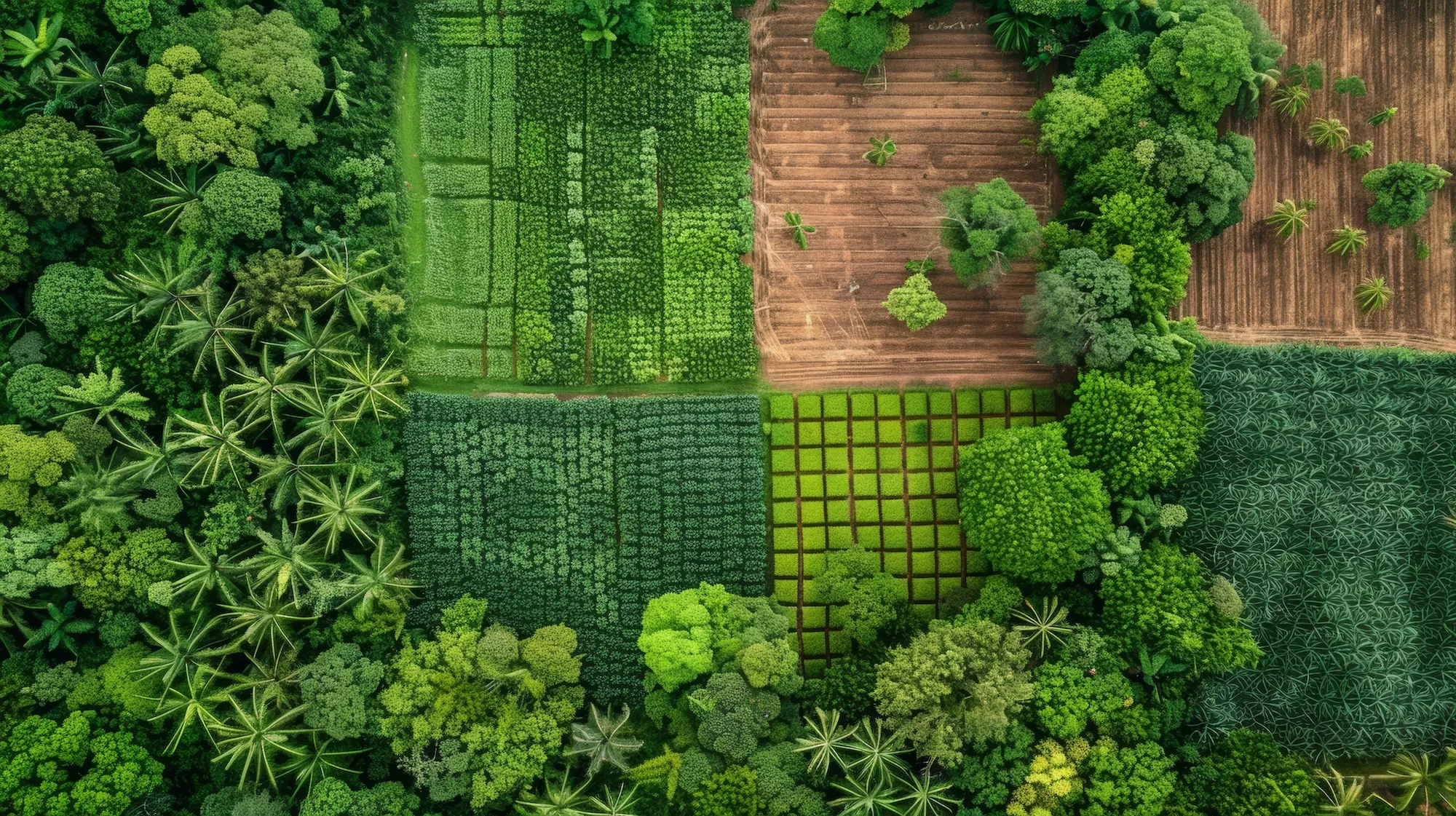


Every morning, in the coffee-growing highlands of East Africa, the soy-rich plains of the Brazilian Cerrado, and the rice paddies of Southeast Asia, a similar story unfolds. A farmer looks at their land and sees potential, the opportunity to transition to regenerative practices, invest in better irrigation, or upgrade their machinery. They have the skill, the will, and the land. But when they walk into a traditional bank, they hit a "paper wall."
This wall is the traditional collateral model. For decades, the global financial system has relied on formal land titles as the primary security for agricultural loans. But for small and medium-sized producers in emerging markets, these titles are often caught in bureaucratic limbo, held in complex family trust structures, or simply non-existent. Without that piece of paper, the bank sees a "high-risk" entity, regardless of how productive the farm actually is. This isn't just a local problem; it is a global crisis of financial exclusion that keeps the at nearly $170 billion annually. When credit is withheld, the entire agricultural engine slows down, preventing the very innovations needed to feed a growing planet and mitigate climate change.
The Barrier: Why the Traditional Model Fails the Field
The failure of the traditional lending model isn't just about a lack of titles; it is about a lack of information. To a bank clerk sitting in a city skyscraper, a 20-hectare farm is a black box. Assessing the risk of that farm requires a manual audit: sending a technician into the field to verify the boundaries, check the crop health, and estimate the potential yield. This process is time-consuming, prone to human error, and incredibly expensive.
The problem is these manual risk assessments are so costly that they often exceed the interest the bank would earn on a smallholder loan. According to the ISF Advisors and the Mastercard Foundation, the global financing gap for smallholder farmers stands at a staggering $170 billion. In Sub-Saharan Africa and parts of Latin America, less than 3% of total bank lending goes to the agricultural sector, despite it accounting for over 20% of the GDP in these regions. This "financial desert" is driven by the fact that traditional banks lose approximately $300 to $500 in administrative costs for every smallholder loan they process, often more than the interest the loan would generate.This creates a "market failure" where credit demand is high, but the cost of supply is prohibitive. Banks aren't necessarily avoiding farmers because they don't trust them; they are avoiding them because they cannot afford to see them. The "audit gap" is effectively a "credit gap.”
Furthermore, traditional credit scores (like the FICO score in the US) are built on consumer behavior, credit card payments, car loans, and utility bills. They ignore the "agricultural truth" of the producer. A farmer might be an expert in regenerative agriculture with a twenty-year history of consistent yields, but if they have lived outside the formal financial system, the bank treats them as a blank slate. This disconnect is what the World Bank identifies as a primary hurdle to building resilient food systems. When the financial system is blind to agricultural performance, it penalizes the most productive stewards of the land.
The Solution: The GPU Power and "Agro-AI"
To break this cycle, we need to replace manual, expensive audits with digital, scalable intelligence. This is where the power of the GPU (Graphics Processing Unit) and Large Language Models (LLMs) enters the agricultural landscape. At Valora Earth, we are moving past the "paper title" by training proprietary AI models on the one thing every farmer has in abundance: data.
In a traditional bank, "data" means a balance sheet or a tax return. In our world, "data" is the "Agricultural Truth" of the farm. We process non-structured data, the "messy" everyday information that traditional banks ignore, to create a more accurate and dynamic Agricultural Credit Score. This shift is made possible by the massive parallel processing power of GPUs, which can analyze thousands of variables simultaneously to identify patterns of risk and success that the human eye would miss.
Training the Agro-AI on Unstructured Data
Think about your daily life on the farm. You likely take photos of your crops to track growth, send WhatsApp voice notes to your consultant about a pest outbreak, and monitor the local rain gauge. To a traditional bank, these are just files. To our Agro-AI, these are high-fidelity signals of management quality.
- Field Photos: AI can analyze a photo of a corn leaf or a soy pod to determine plant health, nutrient deficiencies, and estimated maturity. By comparing thousands of images, the AI can predict yields with higher accuracy than a manual field visit.
- WhatsApp Voice Notes: By processing the language used by producers in their daily communications, AI can gauge a farmer's technical knowledge, their proactive response to threats, and their commitment to the crop.
- NDVI and Satellite History: By looking at the Normalized Difference Vegetation Index (NDVI), we can see years of productivity history from space. We know how the land responds to drought, how quickly it recovers from stress, and how consistent the management has been over decades.
By processing this "alternative data" through dedicated GPUs, we can create a risk profile that is updated every week, not every decade. This isn't just a guess; it is a data-driven decision that reflects the real-time health and resilience of the farm.
The Future: "Data-as-Collateral"
The most transformative concept in this new era is Data-as-Collateral. In this model, the producer’s history of transparency and management excellence becomes the security for the loan. If you can prove, through verified data, that your soil health is improving and your yields are stable, that data has a tangible financial value. It becomes a digital land title.
This shift transforms the relationship between Valora Earth and the producer. We are no longer just a technology provider; we become a facilitator in an embedded finance ecosystem. Embedded finance is a trend where financial services (like credit and insurance) are integrated directly into the platforms farmers already use to manage their fields. The technology doesn't just watch the farm; it funds it.
Why This Reduces Default Rates
The beauty of the "Data-as-Collateral" model is that it is inherently safer for both the lender and the borrower. In a traditional loan, the bank gives the money and then hopes for the best, checking in only when a payment is missed.
Real-world evidence from Ag-Fintech pioneers shows that data-driven lending isn't just faster; it's safer. Recent studies in emerging markets indicate that while traditional agricultural loans often see NPL (Non-Performing Loan) rates of 12% to 15%, digital-first lenders using real-time satellite monitoring and behavioral data have pushed default rates down to below 5%. By replacing "static" collateral (land) with "dynamic" monitoring (NDVI and field logs), the risk of "information asymmetry", where the bank doesn't know what's happening on the ground, is virtually eliminated.
With Valora Earth the management drastically reduces delinquency (default rates) because the technology acts as a co-pilot, helping the farmer succeed. When the farmer succeeds, the loan is repaid, and their credit score improves even further, creating a "virtuous cycle" of financial growth and land restoration.
A Global Perspective: Reclaiming Economic Viability
The impact of this shift is being felt globally, allowing producers to reclaim their economic viability in an increasingly volatile market. In the Brazilian Cerrado, medium-sized farms that were previously "unbankable" are now securing loans to transition to integrated crop-livestock systems, using their historical productivity data as proof of capacity. In North America, producers are using their soil health data to negotiate better interest rates from "green" investment funds that prioritize carbon sequestration.
This democratization of data is the only way to ensure that medium-sized farms can survive the technological era. By moving away from the "sledgehammer" approach of traditional collateral, we are allowing the "scalpel" of precision finance to reach the producers who are actually doing the work of regenerating our planet. This level of investor-grade data is what will finally bridge the gap between rural production and global capital markets.
A Roadmap for the Data-Ready Producer
If you are a farmer looking to leverage your data for better credit, the path starts with transparency. The more "Agricultural Truth" you document, the stronger your "collateral" becomes. You are no longer just growing a crop; you are building a financial asset.
- Digitize Your Baseline: Start recording your field operations today. Even simple records of planting dates, input types, and localized rainfall are valuable data points for an AI model.
- Capture Your Success: Take regular photos of your crops and your soil. If you are applying a regenerative practice, document the transition. This is your digital proof of work.
- Engage with the Assistant: Use voice notes and digital logs to interact with your agronomic assistant. This builds the "behavioral" part of your credit score, showing you are a proactive and knowledgeable manager.
The bank of the future doesn't want your land title - it wants your data.
The transition from "paper titles" to "data titles" is the most significant shift in agricultural economics of the century. By turning the "messy" reality of the field into auditable, investor-grade data, we are finally tearing down the paper wall that has held back smallholder progress. With Valora Earth, your excellence as a producer is finally recognized as your greatest financial asset. It is time to let your data work as hard as you do.