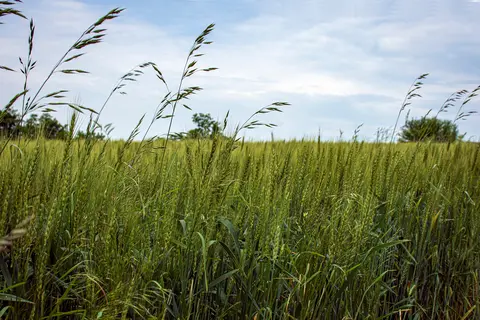
Cover crop termination timing should follow the job you planted the cover to do. Choose one job — nitrogen supply, compaction relief, weed suppression, or grazing — and plant the species that does it best. Then let that job set the kill date. Grass covers such as cereal rye should usually die two to three weeks before a nitrogen-hungry crop like maize. Legumes such as hairy vetch should die late, close to planting, because they keep adding nitrogen until they flower.
These two rules point in opposite directions. So a single calendar rule, such as "kill everything two weeks before planting," is wrong for about half the covers it is applied to. The species decides what the cover can give back. The kill date decides how much of it the next crop receives.
Why one termination rule fails
A well-managed cover crop does not cost the next crop yield on average. A 2017 meta-analysis by Marcillo and Miguez at Iowa State University found neutral to positive effects of winter covers on maize across North American trials. Legume covers raised maize yield by 30–33% where nitrogen fertilizer rates were low or the field had moved to no-till.
The average hides a wide spread, and most of it comes from the kill date. The reason is the carbon-to-nitrogen (C:N) ratio of the residue. When residue C:N is above about 24:1, soil microbes take nitrogen from the soil to break it down — the line University of Nebraska–Lincoln CropWatch (2016) advises staying under.
Grass residue crosses that line as it ages. Penn State Extension (2022) reports young rye near 15:1, about 30:1 at boot stage, and above 40:1 after flowering. Legume residue usually stays well below the line, so a later legume kill simply means more nitrogen.
Which cover crop should I plant for each job?
Plant a legume for nitrogen, forage radish for compaction, cereal rye for weed suppression, and black oat or annual ryegrass for grazing. Each works with a standard grain drill, a broadcast spreader, or hand seeding.
Nitrogen supply: hairy vetch, or mucuna in the tropics
In temperate fields, hairy vetch is the most reliable nitrogen cover. A three-year Agriculture and Agri-Food Canada study in Ontario (Yang, Reynolds and Drury, Frontiers in Soil Science, 2023) measured legume nitrogen credits of 80–85 kg N/ha to maize with fall incorporation. Under no-till, hairy vetch gave higher maize yields than red clover or a clover mix.
In the humid tropics, velvet bean (Mucuna pruriens) works faster. An IITA study in southern Benin (Plant and Soil, 1996) measured about 313 kg N/ha in sole mucuna after 12 weeks, and the next maize crop yielded as if given 120 kg N/ha of fertilizer. Farmers in Benin relay-sowed mucuna between maize rows 40–45 days after maize planting, with no equipment at all.
Compaction relief: forage radish
Forage radish keeps growing where grass roots stop. University of Maryland research (Chen and Weil, 2009) found radish roots were the least restricted by compaction, while rye roots were severely stopped; following maize and soybean roots used the radish channels. In a heavy clay Oxisol in southern Brazil (Revista Brasileira de Ciência do Solo, 2008), radish with black oat doubled macroporosity in the top 20 cm.
Radish makes channels; it does not loosen a whole hard layer. Bulk density did not change in the Brazilian trial, and an Auburn University study (2019) in Alabama found no drop in penetration resistance versus fallow.
Weed suppression: cereal rye, with enough biomass
Rye suppresses weeds through its mulch, so the job depends on tonnage. USDA-ARS researchers (Mirsky, Ryan and Teasdale, Weed Technology, 2013) set the level for consistent annual weed suppression at more than 8,000 kg/ha of dry biomass. Below that, the mulch mostly delays weeds.
Grazing: black oat with annual ryegrass
In southern Brazil, black oat with annual ryegrass is the proven grazing cover before soybean. A Federal University of Rio Grande do Sul trial, grazed since 2001 at sward heights of 10–40 cm, found only the 10 cm treatment put the next soybean crop at risk (2017 assessment).
Keep mixes to two species
Without specialised seeders, use one grass with one legume (rye with vetch, black oat with vetch), or one grass with radish. Similar-sized seeds can share a drill box; broadcast small radish seed separately and cover it with a light harrow pass.
When should I terminate a cover crop before planting?
Kill grasses before boot stage and 14–21 days before maize, kill legumes at early flowering close to planting, and stop grazing at a safe stubble height. The window follows the job, as the table shows.
| Job | Species | Kill window | Main risk of killing late |
|---|---|---|---|
| Nitrogen supply | Hairy vetch, mucuna | Early flowering, 0–10 days before planting | Vetch is harder to kill after full flower |
| Nitrate capture before maize | Cereal rye | Below 20 cm tall or before boot; 14–21 days before planting | Nitrogen tie-up; seedbed moisture loss |
| Weed suppression before soybean | Cereal rye | Flowering (anthesis), rolled or sprayed at or after planting | Moisture use in a dry spring |
| Compaction relief | Forage radish | Frost kill in cold winters; before flowering in mild ones | Seed set and volunteer radish |
| Grazing | Black oat + annual ryegrass | Graze up to desiccation; keep stubble above 10 cm | Thin residue if grazed too low |
Two recent studies set the edges. University of Minnesota Extension (2025) advises killing rye before it reaches 20 cm (8 in) when maize follows. In Argentina, INTA (2025) found that shortening the gap between hairy vetch termination and maize sowing from about 31 to about 10 days improved nitrogen synchrony by 13%.
Weed suppression is the one job where a late grass kill pays. Penn State work led by Mirsky (Weed Science, 2011) found rye biomass rose by about 2,000 kg/ha for each 10-day delay in spring kill. That extra mulch suits soybean, which fixes its own nitrogen, far better than maize.
Cover crop termination timing: what a late kill costs
A late kill costs the next crop water the cover has already used and nitrogen its residue holds back. Climate sets the water cost; species sets the nitrogen cost.
Stored soil moisture
In dry climates, the water cost can outweigh any soil benefit. Kansas State University's long-term study near Garden City, begun in 2007, found wheat yield closely followed plant-available water at planting, and covers grown in place of fallow reduced it. Where wheat yield potential was below about 3.7 t/ha (55 bu/acre), growers should expect a yield loss after a cover. USDA-ARS work at Akron, Colorado (Nielsen and colleagues, 2014) found multi-species mixes used as much water as single species.
In humid regions, the cost can reverse later in the season. A Penn State on-farm study (2015) found late-killed rye dried the top 8 cm of soil in spring, but by early June those plots were wetter under the mulch. In a very dry spring, though, killing rye at or after planting reduced maize yield, while soybean tolerated it.
Nitrogen tie-up
The nitrogen cost of a late grass kill is predictable enough to budget. Penn State Extension (2022) reports that rye maturing from 15:1 to 40:1 C:N can raise maize nitrogen needs by 22–56 kg N/ha (20–50 lb/acre). In the Penn State on-farm trials, the site that skipped side-dress nitrogen after late-killed rye lost maize yield; sites that side-dressed did not.
Worked example: rye or vetch before maize
Take a maize field to be planted on 10 May with a planned rate of 160 kg N/ha.
Rye, killed early. Kill on 20 April, 20 days before planting, while the rye is under 20 cm and leafy (C:N near 15–20:1). No extra nitrogen is needed, and the rye returns most of the nitrate it caught over winter.
Rye, killed at planting. By 10 May the rye is at boot or flowering (C:N 30–40:1). Budget an extra 40 kg N/ha, the middle of Penn State's range, placed at planting. That is about 87 kg/ha of urea (46% N). At an illustrative urea price of USD 0.45/kg, the late kill costs about USD 39/ha, or USD 780 on 20 ha, before any moisture loss.
Hairy vetch, killed late. Kill at early flowering, within 10 days of planting. Cut the side-dress rate by 40–60 kg N/ha — below the Ontario 80–85 kg credit, because no-till credits run lower and vary more — and confirm with a pre-side-dress soil nitrate test. That saves 87–130 kg/ha of urea.
The rule that follows: before maize, kill grass early unless weeds are the job. Before soybean with weed pressure, let rye reach flowering and roll it. In semi-arid fields with low yield potential, kill early whatever the species, or leave the field in fallow.
Frequently asked questions
Can I plant soybeans into a living cover crop?
Yes, and soybean tolerates it better than maize. Planting into standing rye and killing it at or after planting builds more mulch for weed control. Because soybean fixes its own nitrogen, rye tie-up matters less. In a very dry spring, kill earlier so the rye does not draw down seedbed moisture.
Does forage radish need to be terminated?
Where winters bring hard frost, forage radish usually dies on its own, so no termination pass is needed. In mild climates it can survive, flower and set seed, which leaves volunteer plants in the next crop. There, mow, roll or spray it before flowering, or sow it later in autumn to limit growth.
How can I tell if rye residue will tie up nitrogen?
Use growth stage as a field guide. A 2024 study of rye and triticale on California vegetable farms, presented to the American Society for Horticultural Science, found the C:N ratio crossed 20:1 between flag-leaf emergence (Feekes 9) and boot stage (Feekes 10). Killing before boot keeps tie-up low.
Getting the kill date right means tracking growth stage, planting date and rainfall field by field. Valora Earth's WhatsApp advisor can work back from a farmer's planned planting date and the local rainfall forecast to suggest a termination window for each cover.