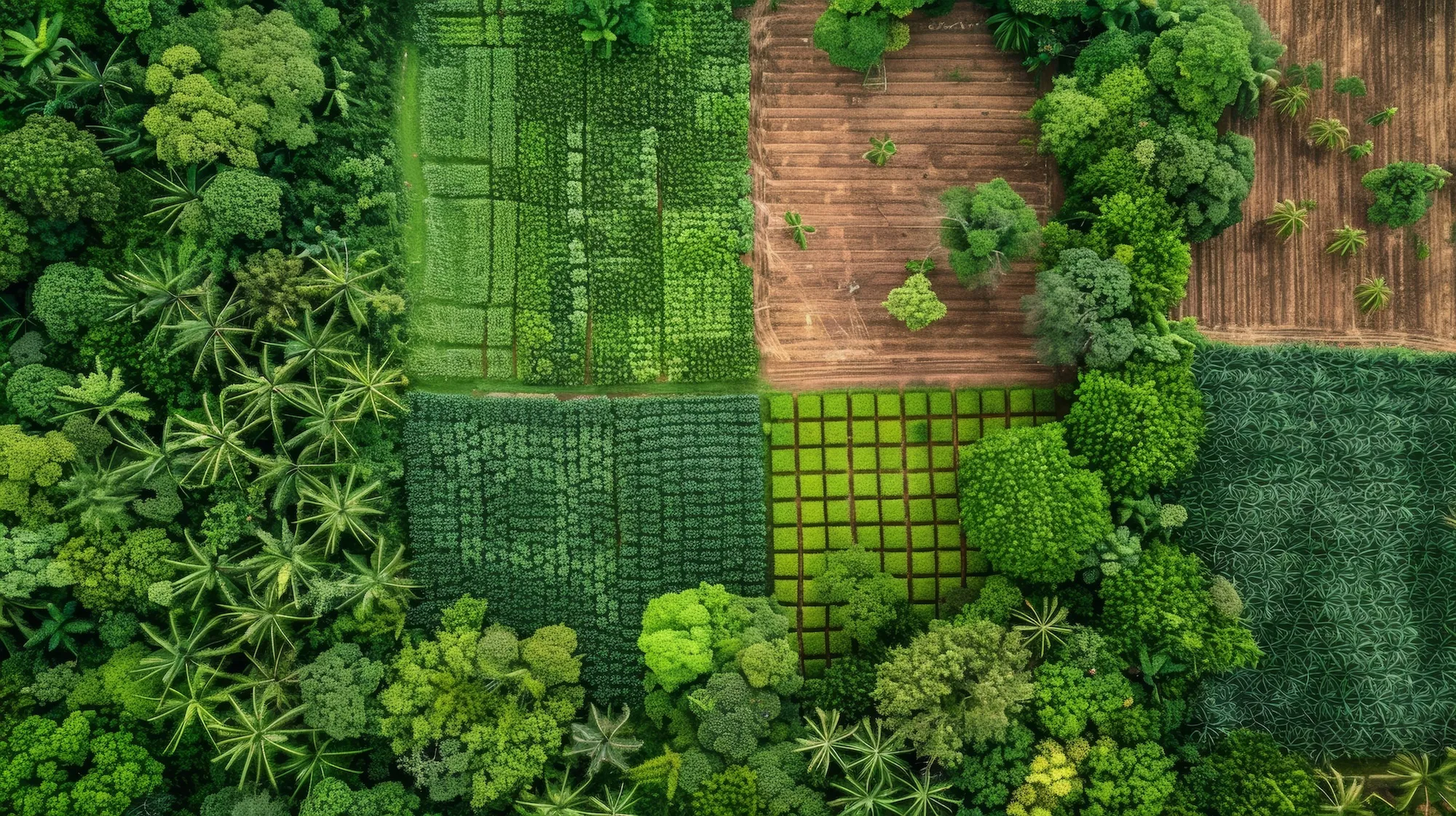


Imagine standing at the edge of a pristine tropical rainforest. You notice the layers immediately: the towering canopy absorbing the harsh midday sun, the understory thriving in the dappled light, and the ground cover protecting the soil from torrential rains. Now, imagine your farm functioning with that same biological intelligence, but optimized for food production and profitability.
For small and medium-sized farmers across the tropics—from the coffee highlands of Colombia to the cocoa belts of West Africa—the shift from monoculture to agroforestry is not just an environmental choice; it is a strategic business decision. By designing a system that mimics nature, you can reduce reliance on expensive chemical inputs, protect your crops from extreme weather, and create a legacy of soil fertility for future generations.
Designing a successful agroforestry system requires more than just planting trees in a field. It requires a careful choreography of space, time, and species. Here is how to approach the design process, blending ancient wisdom with modern agricultural science.
Step 1: Read Your Land Before You Plant
Great design begins with observation. Before selecting a single seed, you must understand the unique narrative of your landscape. In tropical settings, where rainfall can be intense and sunlight unforgiving, the physical characteristics of your land dictate what is possible.
Start by mapping your topography. A 2024 training manual by the Center for Agroforestry emphasizes that understanding slope and drainage is critical for preventing erosion. If your land is hilly, your design should prioritize contour planting, where trees are planted in lines perpendicular to the slope to act as living barriers against soil runoff.
Next, analyze your soil’s history. Has it been compacted by years of cattle grazing? Is it depleted from continuous maize or cassava cropping? In degraded soils, your "pioneer" species—the first trees you plant—must be rugged nitrogen-fixers that can break up hardpan and restore fertility.
Step 2: Choose Your System Architecture
Once you know your land, you must decide on the structural "skeleton" of your farm. While there are dozens of variations, three main architectures dominate tropical agroforestry:
Alley Cropping
This is often the entry point for farmers transitioning from annual row crops. Here, you plant rows of trees (often fast-growing legumes like Gliricidia sp. or Leucaena sp. ) and grow your cash crops—maize, beans, or vegetables—in the "alleys" between them. The trees provide shade, mulch, and nitrogen, while the crops provide short-term income.
Silvopasture
For those managing livestock, silvopasture integrates trees into grazing lands. In parts of Brazil and Costa Rica, farmers have successfully combined timber trees with cattle grazing. The trees reduce heat stress on the animals—which can significantly improve milk and meat yields—while the animals provide manure to fertilize the trees.
Multi-Strata (Food Forests)
This is the most complex and rewarding system, widely seen in the home gardens of Indonesia and the Philippines. It involves stacking plants in layers: root crops underground, bushes and small trees (like cacao or coffee) in the middle, and timber or fruit trees (like durian or mahogany) in the canopy. This density maximizes photosynthesis and yield per square meter.
Step 3: Selecting the Right Species
If the architecture is the skeleton, the species you choose are the muscle. The golden rule of tropical agroforestry is compatibility. You want plants that cooperate rather than compete.
The Anchor Trees (Canopy)
These are your long-term investments. In a tropical setting, high-value timber trees like Mahogany or Teak, or large fruit trees like Mango and Jackfruit, serve as the overstory. They regulate the microclimate for the crops below. However, ensure their root systems are deep so they don't steal water from the shallow-rooted crops on the surface.
The Service Trees
Often unsung heroes, these trees are planted primarily to support the system. Leguminous trees like Inga edulis (Ice Cream Bean) are popular in Latin America because they fix atmospheric nitrogen into the soil, reducing the need for synthetic fertilizers. According to the CGIAR Research Program on Forests, Trees and Agroforestry, integrating nitrogen-fixing trees can improve soil nutrient availability for adjacent crops by up to 30%.
The Cash Crops (Understory)
These are your economic engines. Shade-tolerant crops like coffee, cacao, turmeric, and ginger thrive under the protection of the canopy. By mimicking their natural forest habitats, you often get a higher quality product. For instance, shade-grown coffee typically ripens more slowly, developing complex flavor profiles that fetch premium prices.
Step 4: Spatial and Temporal Design
One of the most common mistakes in agroforestry is overcrowding. A young tree looks small today, but in five years, it could be casting a dense shadow that kills your vegetable crop.
Managing Light and Space
You must design for the mature size of your trees. If you are alley cropping, the alleys must be wide enough to allow sunlight to reach the lower crops, or you must commit to regular pruning. In tropical regions near the equator, planting tree rows in an East-West orientation is often recommended to maximize sunlight exposure for the crops in the alleys throughout the day.
Designing for Time (Succession)
Think of your farm in four dimensions, with time being the fourth.
- Year 1-2: You plant your timber trees and service trees. While they establish, you grow sun-loving annuals (corn, peppers) between them.
- Year 3-7: As the canopy closes, you shift to shade-tolerant crops like cacao or vanilla. Your fruit trees begin to bear.
- Year 15+: You may harvest some timber trees, opening gaps in the canopy to restart the cycle or introduce new crops.
This concept, known as successional agroforestry, ensures you have a continuous stream of income rather than waiting 20 years for a timber harvest.
Step 5: The Economic and Ecological Payoff
Adopting these systems requires an upfront investment of labor and learning, but the data supports the effort. The Food and Agriculture Organization (FAO) highlights that agroforestry systems significantly increase biodiversity, which provides natural pest control. When you have a diverse mix of plants, you attract beneficial insects and birds that keep pest populations in check, reducing your reliance on expensive pesticides.
Furthermore, these systems are a powerful buffer against climate change. The Intergovernmental Panel on Climate Change (IPCC) has identified agroforestry as a key land-use strategy for climate adaptation. In the face of increasingly erratic tropical weather patterns—from droughts to typhoons—the deep roots of trees stabilize the soil, and the canopy lowers ambient temperatures, protecting your livelihood from the extremes.
Cultivating a Legacy
Designing an agroforestry system is an act of hope and a commitment to the future. It transforms farming from an extraction industry into a regenerative one. By observing your land, choosing compatible species, and respecting the layers of the forest, you can build a farm that feeds your family and heals the planet simultaneously.
The transition doesn't happen overnight. Start small—perhaps with a single alley cropping plot or a boundary windbreak—and let the results convince you. As your trees grow, so too will the resilience of your farm.