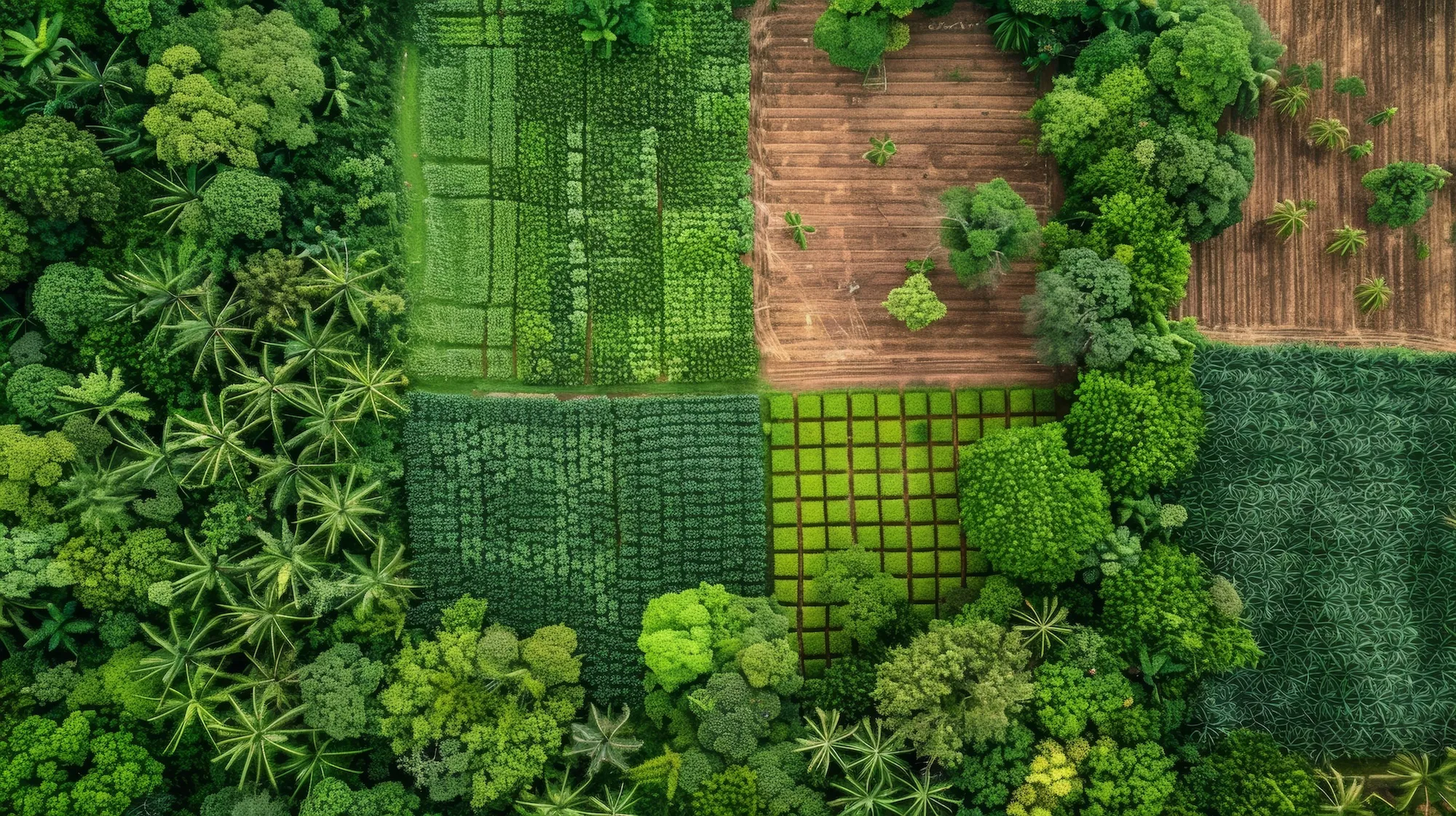


Every farmer knows their yield. Whether you are harvesting wheat in Kansas or cassava in Nigeria, you can weigh your output and calculate your profit. But there is another crop growing on your farm, one that is becoming increasingly valuable, yet remains frustratingly invisible: soil carbon.
For the regenerative farmer, soil carbon is the ultimate asset. It is the sponge that holds water during droughts and the pantry that feeds plants during the growing season. Recently, it has also become a tradable commodity in the fight against climate change. However, for small and medium-sized farmers, proving that you are storing carbon has historically been a logistical nightmare.
The traditional method—physical soil sampling—is slow, labor-intensive, and prohibitively expensive. It can cost more to verify a carbon credit than the credit is worth. This creates a barrier that keeps the carbon market exclusive to massive industrial operations.
But the script is flipping. We are witnessing a technological revolution where remote sensing—the science of scanning the earth from a distance—is combining with artificial intelligence to measure soil health from the sky. Here is how these advancements are changing the game for farmers worldwide.
The Bottleneck: Why We Need "Eyes in the Sky"
To understand the solution, we must first appreciate the problem. Soil is notoriously heterogeneous. You can test a square meter in one corner of a paddock and get a high carbon reading, then walk fifty paces and get a completely different result due to a change in soil texture or moisture.
To get an accurate baseline using traditional methods, you need dozens of samples per hectare. For a smallholder farming two hectares in the tropics, the cost of laboratory analysis is often higher than their annual income. This reality has stalled the potential of soil carbon sequestration to act as a global climate solution.
As the Food and Agriculture Organization (FAO) emphasizes, we cannot manage what we cannot map. To scale regenerative agriculture, we need a way to monitor millions of hectares cheaply, accurately, and repeatedly.
How Satellites "See" Carbon
It might seem like science fiction that a satellite orbiting 700 kilometers above the Earth can analyze the dirt on your boots. In reality, it is based on the science of light, or spectroscopy.
Everything on Earth reflects sunlight, but different materials reflect it in unique ways—a "spectral fingerprint." Healthy, carbon-rich soil is generally darker and reflects light differently in the near-infrared spectrum compared to degraded, sandy soil.
1. Optical Sensing: The First Generation
Early attempts used standard optical satellites (like the Landsat program) to look at bare soil color. This was useful but limited. It couldn't "see" through crop cover, meaning you could only measure soil carbon during the short window after harvest and before planting.
2. Hyperspectral Imaging: Seeing the Details
The newest generation of satellites uses hyperspectral imaging. Instead of seeing just red, green, and blue, these sensors see hundreds of narrow bands of light. They can detect subtle chemical compositions on the surface. NASA’s Earth Science Division is deploying missions that can differentiate between soil organic matter and other surface features with startling precision, allowing models to estimate carbon content even in complex landscapes.
3. Radar: Piercing the Clouds
For farmers in the tropics—from Brazil to Indonesia—optical satellites have a major weakness: clouds. If it’s cloudy, the satellite is blind. This is where Synthetic Aperture Radar (SAR) comes in. SAR sends down radio waves that punch through clouds and bounce back to the sensor.
While radar doesn't "see" carbon directly, it measures soil structure and moisture with incredible accuracy. Since soil carbon heavily influences soil structure and water-holding capacity, AI models can use this radar data to infer carbon levels. This ensures that farmers in rain-heavy regions aren't left out of the data revolution.
The Brains of the Operation: AI and Machine Learning
Satellites provide a firehose of data—petabytes of images that would take a human lifetime to analyze. This is where Artificial Intelligence (AI) steps in.
Researchers are training machine learning models to connect the dots. They take a high-quality physical soil sample (the "ground truth") and match it with the satellite image of that exact spot taken on the same day. By repeating this thousands of times, the computer learns to recognize the pattern: "When the satellite sees this specific spectral signature, the soil carbon is 2.5%."
A study published in Nature Reviews Earth & Environment highlights that these hybrid models—combining satellite data with environmental covariates like topography and climate data—are rapidly closing the accuracy gap with physical sampling.
Why This Matters for the Small Farmer
This technology sounds expensive, and the satellites are. But the data is becoming democratized. This shift from physical to digital verification unlocks three critical doors for small and medium-sized farmers:
1. Drastic Cost Reduction
Once a satellite model is calibrated for a region, scanning a farm costs pennies per hectare compared to dollars for physical testing. This reduces the transaction costs of carbon credits, meaning more of the money goes to the farmer rather than to consultants and laboratories.
2. Aggregation
Remote sensing allows project developers to monitor thousands of small farms simultaneously. A cooperative of 500 maize farmers in Kenya can be monitored as a single "carbon block." If the satellite detects that a farmer has plowed their field (releasing carbon), the system flags it instantly. This transparency builds trust with carbon buyers and allows smallholders to participate in global markets.
3. Precision Management
Beyond carbon credits, these maps help farmers farm better. The same satellite data can reveal nitrogen deficiencies, moisture stress, or erosion risks. Platforms are emerging that deliver this insight directly to a farmer's smartphone, turning complex orbital data into a simple suggestion: "Field B is losing moisture; consider increasing residue cover."
The "Ground Game": Handheld Tech
While satellites handle the big picture, technology is also shrinking the lab and putting it in the farmer's pocket. Handheld spectrometers are becoming more common. These devices, which look like barcode scanners, use similar light-sensing technology to give an instant readout of soil organic carbon in the field.
While these devices still require some calibration, they allow for rapid "ground-truthing." A crop advisor can walk a field, take fifty scans in an hour, and generate a high-resolution carbon map without shipping a single bag of dirt.
Challenges and the Road Ahead
Despite the excitement, we must maintain a healthy dose of realism. Remote sensing is not a magic wand—yet.
The Depth Issue: Satellites primarily scan the surface (top 0-5 cm). However, regenerative agriculture often sequesters carbon deep in the soil profile through root exudates. The Soil Health Institute notes that accurately modeling deep carbon from surface readings remains a scientific challenge that requires continuous calibration.
The Data Desert: AI models are only as good as the data they are trained on. Currently, most soil data comes from North America and Europe. To work for a farmer in India or Peru, the models need local training data. We need a global effort to share soil libraries to prevent a "data bias" that favors the Global North.
Connectivity: Accessing these insights requires internet connectivity. For remote sensing to truly democratize agriculture, we must bridge the digital divide that leaves many rural communities offline.
Conclusion: A Hybrid Future
The future of soil measurement will likely not be purely digital or purely physical—it will be a hybrid. Satellites will provide the scale, handheld sensors will provide the agility, and physical samples will provide the ground truth to keep the system honest.
For the regenerative farmer, these advancements are a validation of your hard work. For years, you have known that your soil is changing—it feels spongier, smells richer, and looks darker. Now, we finally have the eyes to see what you have built, and the tools to value it properly.